
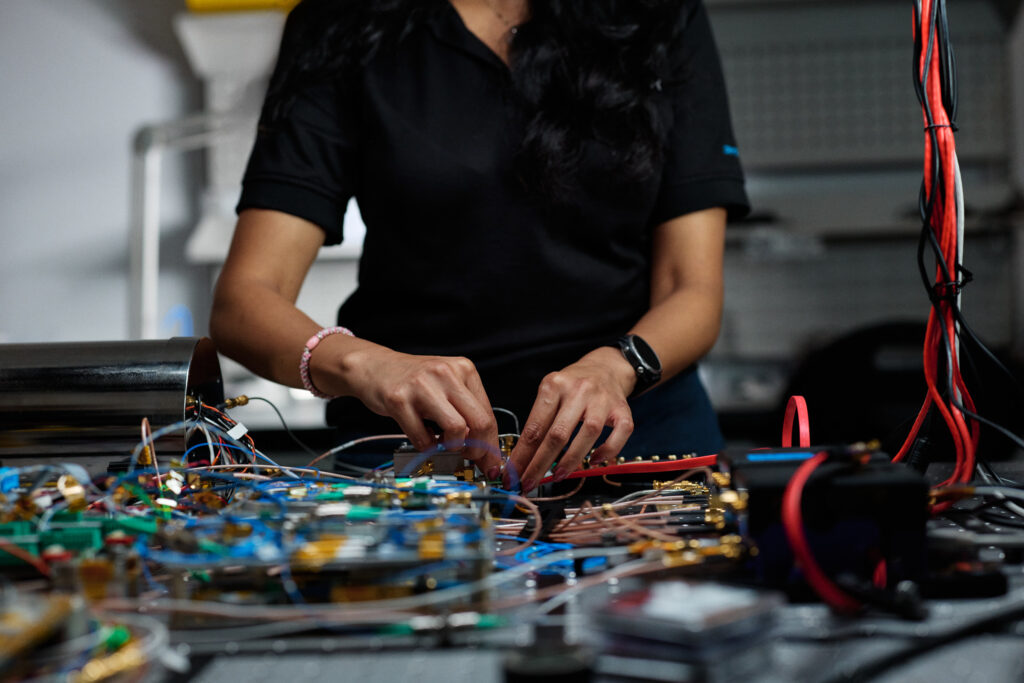
A sub-system payload of TEMPO, the compact optical atomic clock developed by QuantX Labs, is now in orbit following its 30 March launch aboard the SpaceX Transporter-16 mission with French space mobility company Exotrail’s Spacevan002. It is one of the most advanced Australian-built quantum technologies ever deployed in space.
2026 National Defence Strategy and Integrated Investment Program
The milestone pre-empted a defining two-week stretch for Australia’s quantum sector. World Quantum Day was marked on 14 April. The Albanese Government released the 2026 National Defence Strategy and Integrated Investment Program on 16 April, committing $425 billion over the decade with undersea warfare and resilient multi-orbit satellite communications ranked as the first and seventh priorities of the Integrated Investment Program. From Tuesday, more than 1,000 delegates will gather at the Adelaide Convention Centre for the Quantum Australia Conference 2026, themed Quantum for Impact.
TEMPO delivers up to ten times the performance of current GNSS-based timing systems. In space, that translates to more resilient communications, more accurate navigation and harder-to-disrupt synchronisation between satellites and ground systems – capabilities that matter when GPS is jammed, spoofed or unavailable.
The technologies built by QuantX Labs and developed in partnership with The Institute for Photonics and Advanced Sensing (IPAS) at Adelaide University, map directly onto two of the Government’s seven stated investment priorities.
Resilient satellite communications.
The Integrated Investment Program commits $9-$12 billion to enhanced space capabilities, with a rescoped focus on a resilient, multi-orbit Australian Defence Satellite Communications capability. Precision atomic clocks are foundational to keeping satellite constellations synchronised and communications secure under electronic attack and frequency combs are significant future technology for space communications. TEMPO’s presence in orbit is a working demonstration of that capability built in Australia.
Undersea warfare.
QuantX Labs is also developing SENTIO, an extremely sensitive quantum magnetometer capable of detecting objects underwater and underground.
The Integrated Investment Program lists an enhanced undersea warfare capability as its first priority, supported by a sovereign fleet of conventionally-armed, nuclear-powered submarines. Quantum magnetometry is one of the most promising emerging technologies that can detect submerged targets in GPS-denied environments without relying on traditional acoustic signatures.
Both sit inside a product suite that also includes CRYO clock, which has been developed for readiness into the $1.2 billion AIR2025 Phase 6 upgrade of the Jindalee Operational Radar Network (JORN).
“Getting an Australian-built optical atomic clock subsystem into orbit is a moment we have been working towards for more than twenty years. It is proof that deep research done in Australia can end up on a SpaceX rocket in partnership with a European space company, delivering capability that matters to our customers and our country.
“The 2026 National Defence Strategy has put resilient communications and undersea warfare at the top of the priority list. Precision timing and quantum sensing are foundational to both. We are already building what the Strategy is asking for,” says Professor Andre Luiten, our Co-Founder and CEO.
“QuantX Labs is what research translation looks like when it works. Two decades of precision timing research, led by the Institute for Photonics and Advanced Sensing, has matured into a product now being primed to operate in orbit and lining up against the most urgent capability priorities in the National Defence Strategy.
“Adelaide University was built for moments like this. Sovereign capability is not an abstraction — it is students, postdocs and researchers working alongside world-class scientists, engineers and industry to get something out the lab and into space,” shares Professor Anton Middelberg, Deputy Vice Chancellor – Research and Innovation, Adelaide University.
Quantum Australia
World Quantum Day (14 April) marked the international recognition of quantum science and its growing role in defence, health, communications and computing. Two days later, the 2026 National Defence Strategy reframed quantum-relevant capabilities — resilient satcom, undersea warfare, counter-uncrewed systems, long-range strike — as immediate national priorities backed by an additional $53 billion over the decade.
The Quantum Australia Conference 2026 opens in Adelaide on 29 April with the theme Quantum for Impact, focused on how Australian quantum research is being turned into commercial products, sovereign capability and export revenue. The TEMPO launch is one of the clearest answers to that question the country has produced.
According to the 2024 State of Australian Quantum report, Australia’s Quantum sector has now attracted more than $1 billion in quantum research and commercialisation investment with a further $1 billion earmarked for critical technology and quantum companies through the National Reconstruction Fund. South Australia, with Adelaide University, Defence Trailblazer and the Lot Fourteen precinct, has positioned itself as a national hub for quantum timing, sensing and defence applications.