A clock with a sapphire heart, a glue to patch wounds back together and a set of reading glasses that could one day let you see in the dark are among the inventions and discoveries that have won Eureka Prizes, Australia’s top awards for science.

This year’s prizes, handed out on Wednesday night, recognise some of this country’s leading minds, often for inventions that are changing our lives.

Eureka Prize winner Professor Tony Weiss.

Professor Tony Weiss, from the University of Sydney, won for his work with a team that developed a surgical glue that can stick together severed arteries and patch up punctured lungs.

The glue, called MeTro, is made from a natural elastic protein and sets in just 60 seconds when a UV light is shone on it. It has a built-in chemical that breaks it down over time as the body heals and  doctors can even specify how long they want the glue to last – from hours to months.

“Wouldn’t it be amazing to have a material that you could squeeze onto a broken blood vessel and seal it up? Onto a collapsed lung, so you can start breathing again?” Professor Weiss said in a video released by his University.

“We have developed a material that can do just that.”

Professor Weiss was awarded the Eureka Prize for Innovation in Medical Research.

Sixteen prizes and $160,000 in prize money were handed out at the ceremony, at Sydney’s Town Hall. Ten of the 16 prizes were won either by women or by teams that included women.

Imagine a clock that was accurate – really, really accurate. That’s what a team from the University of Adelaide have built, using a sapphire crystal to make a timekeeper that’s accurate to one second in 40 million years.

It is the world’s most-accurate clock.

The synthetically grown sapphire at the clock's heart has a near perfect crystal structure.
The synthetically grown sapphire at the clock’s heart has a near perfect crystal structure.

The super-cooled sapphire, which sits at the heart of the clock, was specially grown in a lab to have almost no impurities – making it clear, instead of a sapphire’s usual pink or blue.

The clock was developed in part to upgrade the Jindalee Over-The-Horizon Radar Network, which scans for threats far beyond Australia’s shoreline.

“The sensitivity to detect objects at great distances depends on the purity of the reference clock frequencies,” said Professor Andre Luiten, Director of the University of Adelaide’s Institute for Photonics and Advanced Sensing.

“Our Sapphire Clock would allow the network to generate signals that are 1000 times purer than its current technology.”

The Sapphire Clock Team from the Institute for Photonics and Advanced Sensing at the  University of Adelaide.
The Sapphire Clock Team from the Institute for Photonics and Advanced Sensing at the University of Adelaide.

“If the network has access to better signals then it will be able to see smaller objects, travelling slower, at much greater distances – and that means keeping Australia safer.”

The Institute’s clock team won the Eureka Prize for Outstanding Science in Safeguarding Australia.

Dr Mohsen Rahmani wears glasses.

Sadly, his cannot see in the dark – but he hopes to change that.

The Australian National University researcher won the Eureka Prize for Outstanding Early Career Researcher for developing a very thin layer of smart nanoparticles that can work as sensors, including for night-vision technology.

His research can also be used in building super-thin sensors to track human health biomarkers; several companies are looking at ways of commercialising it in products such as lenses and smart mirrors.

“The winners of the 2018 Australian Museum Eureka Prizes show us yet again how Australia’s scientists are kicking the big goals – they are making impacts in many areas of global significance,” Australian Museum director Kim McKay said.

https://www.smh.com.au/national/eureka-brains-behind-sapphire-clock-wound-glue-scoop-science-prize-20180829-p500iw.html


IT’S A doomsday clock of a different kind and it can pinpoint threats to our nation with precision accuracy.

In fact, the clock is the best in the world because of its ability to hold time better than anything else.

Basically, the Sapphire Clock keeps time within one second over 40 million years.

The reason that’s important is because its precision accuracy enhances our current defence radar system, allowing even more detailed information to be received about missiles, planes and ships that could be a threat to Australia.

University of Adelaide’s Institute for Photonics and Advanced Sensing director Professor Andre Luiten said the technology that could save Australia came about in a “dusty basement” 20 years ago.

Scientists have spent decades perfecting the advanced device that has the potential to be rolled out to other industries such as our telecommunications network.

Prof Luiten said accurate clocks were what was needed to make so many everyday devices work better which was why such work was so important.

“Accurate clocks are sitting inside lots of things,” he said. “When you want things to work together nicely you need to have clocks everywhere, they’re buried inside devices.”
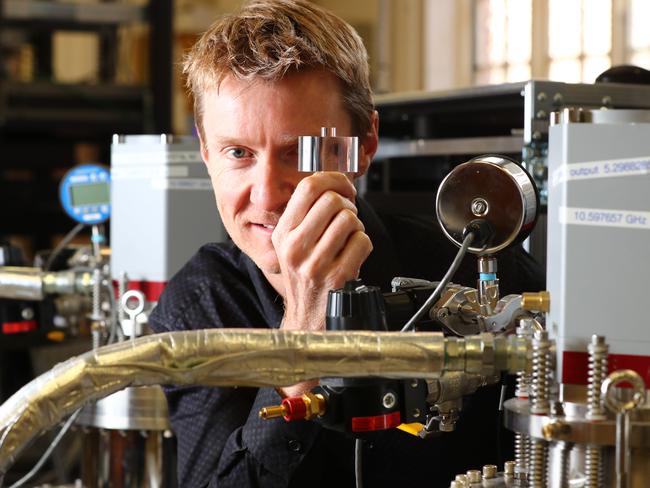
Associate Professor Martin O'Connor in the Sapphire Clock lab. Picture: Tait Schmaal

Associate Professor Martin O’Connor in the Sapphire Clock lab. Picture: Tait Schmaal

The Sapphire Clock was designed to work alongside Australia’s current linchpin for defence, the Jindalee Over-The-Horizon Radar Network (JORN) system, to emit signals that are 1000 times purer than current methods, which means even smaller objects can be seen at even greater distances.

The radar works by broadcasting signals with information as to how far these objects are and where, encoded in radio waves that bounce between the atmosphere and earth.

“The better signals you can send out the better information you can drive,” Prof Luiten explains.

“Sending a pure signal with radar depends on access to clocks, and the better quality the clock, the better information.

“It’s pretty magic stuff, they’re sending signals out and a tiny, tiny amount of that power comes back. The purer the signal, the smaller the change you can measure in the signal coming back and that gives you more precise information.

“This will make all Australians safe.”

The clock gets its name from the piece of sapphire it uses, which ticks better than other materials such as the quartz found in our watches or mobile phones.
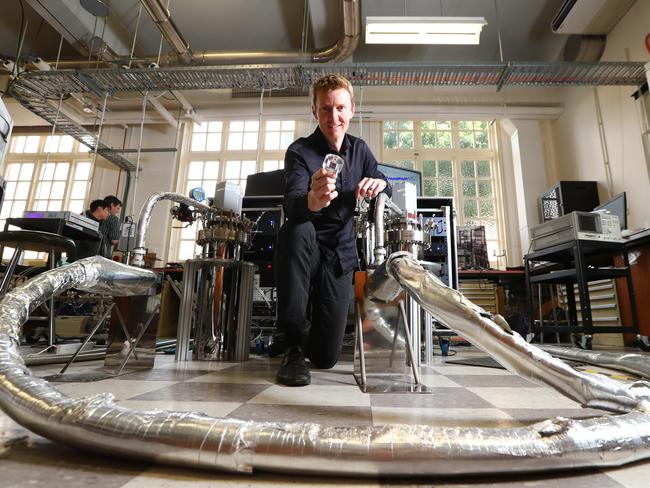
The team hopes the applications will be more far reaching than defence. Picture: Tait Schmaal

The team hopes the applications will be more far reaching than defence. Picture: Tait Schmaal

The sapphire operates at an extremely low temperature — four degrees above absolute zero or minus 269C.

“At that crazy low temperature it basically is a perfect vibrating bell,” Prof Luiten said.

“The analogy is if it was a bell and you struck it, it would ring for more than a month.

“It’s like a glorified grandfather clock, it repeats over and over again and it repeats in a very particular way.”

Prof Luiten said he and his colleagues hoped the clock would do more than protect Australians.

“This will hopefully do more than safeguard Australians but generate jobs and wealth,” he said.

“One of the really exciting markets is the next generation of mobile phones, 5G, that requires really good timing systems at the base of this telecommunication network.

“It would be an absolutely huge market. That’s the long-term vision.

“Our clock is the best clock in the whole world because it hold times better than anything else.”

Prof Luiten said the clock would be tested later this year.

This week it was recognised in Australia’s leading science awards, the Australian Museum Eureka Prizes, in the category of outstanding science in safeguarding Australia.

“It’s so amazing that science has taken us from a dusty basement to an award-winning technology that’s gong to end up safeguarding all Australians,” he said.

Quantum mechanics, photonics could hold key to securing personal data

By Tom Fedorowytsch
Posted 
“What we’re trying to do is make an absolutely secure, private communications network,” Ben Sparkes, a research fellow on the project, said.

“Current technology relies on mathematics to encrypt information, so things like a Facebook post, your emails and your banking details, are all protected from outside nefarious evildoers — individuals, corporations or even countries — by maths.

“Unfortunately it’s not impossible to crack that encryption, and with the advent of quantum computers, it’ll be much easier to do.”

The university’s Institute of Photonics and Advanced Sensing, which has also developed what they say is the world’s most precise timing system, wants to take the principles of quantum mechanics and use it to lock down communications.

Laboratory in the Institute for Photonics and Advanced Sensing at the University of Adelaide
The researchers are using the principles of quantum mechanics.()

“In quantum mechanics, light is not just a wave, but made of tiny individual particles called photons, which can be in many different places and states at the same time. And if you try to measure that photon or state, it will choose between one of those many different states,” Dr Sparkes said.

“If you combine all those together, then you get a technique which no-one can actually break.”

The main hurdle is that photons start to get lost after about 200 kilometres of travel, so it could take 10-20 years to perfect the technology.

“[So it’s] single particles of light to send secret messages between people, hopefully over a very long distance, to make it useful for defence, banking et cetera into the future,” Dr Sparkes said.

‘Exploiting the power of light’: Team’s other pursuits

The same team has also developed a clock so accurate it only loses a second once every 40 million years.

A 25-year labour of love, scientists at the Institute for Photonics and Advanced Sensing have successfully built and marketed the so-called sapphire clock.

A digital screen attached to a sapphire crystal clock.
The Sapphire Clock ticks 10 billion times per second to produce hyper-accurate measurements.()

Based on a lab-grown, 1,200-carat sapphire, it ticks 10 billion times per second to produce hyper-accurate measurements.

“Sapphire clock is 1,000 times more precise than any other commercial system currently available,” Associate Professor Martin O’Connor said.

“We’re partnering with the Commonwealth of Australia in using sapphire clock to improve the radar signals on Australia’s Jindalee Operational Radar Network.”

Associate Professor Martin O'Connor smiles as he holds the sapphire clock crystal.
The Sapphire Clock crystal, held by Martin O’Connor, was grown in the lab.()

Researchers say it will give the radar a boost in range, and the sensitivity to detect small, slow-moving objects.

The institute’s director, Professor Andre Luiten, said the advance in photonics and other light-bending technologies already generates billions of dollars in revenue for Australia, and employs thousands of people.

“The institute is all about exploiting the power of light, to make the world healthier, wealthier, and safer,” he said.

“You don’t just have great ideas and do research, but you need a pathway to actually push those objects out in to the market.”

Reposted From: ABC Science, full article below.

An Australian scientist has developed a clock so accurate it is expected to lead to a new standard for defining time.

The new clock is so stable over short time periods, it is equivalent to a clock that loses or gains only one second every 40 million years.

“All clocks are based on some repetitive element, like the swing of a pendulum in a grandfather clock,” says the University of Western Australia‘s Dr Andre Luiten, whose work has just won him an international science award.

Since 1967, global time-keeping has been determined by so-called “atomic clocks” – with the repetitive phenomenon being the natural oscillation of a particular frequency of radiation emitted by atoms of caesium.

But Dr Luiten’s new clock is based on the repetitive bouncing of microwaves pumped inside a crystal of sapphire.

The fist-sized crystals – grown artificially in the United States and worth around $10,000 each – are kept at minus 267 degrees celcius and have very special properties.

So long as their temperature is held constant to within one ten millionth of a degree, the number of times the microwaves bounce back and forth inside the crystal stays remarkably constant, making them ideal for accurate time keeping.

Dr Luiten’s team is one of three around the world which have been working on developing these “microwave clocks”, which are 10,000 times more accurate than atomic clocks over short time periods (less than a day).

But his selection as Young Scientist of the Year, awarded by the Union Radio-Scientifique Internationale, recognised Australia’s cutting edge role, Dr Luiten told The Lab.

The WA team’s clock is better than any other in the world at defining time over short periods.

While a modified version of the technology was already being applied in radar and communication systems, the most accurate version was still a research tool. But one with huge potential.

Already the European Space Agency has invited Dr Luiten to build one of six clocks to be sent into orbit on the International Space Station, where it would play a role in research aimed at testing if “universal constants” like the speed of light, really are constant in time and space. The orbiting clock would also help define a new international standard for time.

“Being able to align the world’s clocks to a billionth of a second might sound esoteric, but it has enormous implications in telecommunications,” Dr Luiten said. “You need to be able to time the exchange of information very precisely.”

Because microwave clocks are most accurate over short time periods, they may produce the best results when combined with atomic clocks, which are most accurate over longer time periods.

A combination sapphire and caesium clock, built by Dr Luiten’s team in collaboration with the Laboratoire Primaire du Temps et des Fréquences (LPTF), has already yielded a world record for time keeping with an accuracy equivalent to one second in 50 million years.